Stock market overview
The stock market (also called stock exchange, share market or equity market) is a regulated and controlled environment where traders can buy and sell shares.
The stock market ensures price transparency, liquidity, price discovery and fair dealing, giving all market participants access to the data on all buy and sell orders.
The stock market is part of a free-market economy. It allows companies to raise money by issuing shares and corporate bonds, and it allows investors to share in the companies’ success, making profits through capital gains and earning income through dividends.
Shares
Shares represent ownership in a public company.
The terms “shares” and “stocks” are often used interchangeably, but there is a difference: a company issues stock, and you buy shares of it. For example, if each share represents 1% of a company and you buy 10 shares, you own 10% of the company.
Warning: Shares represent ownership, not debt. The company has no legal obligation to pay shareholders back if something happens to the business.
Types of shares
- Common shares: come with voting rights, giving shareholders more control over the business. These rights allow them to vote on specific corporate actions.
- Preferred shares: usually have set payment terms, like a dividend paid out regularly, and take priority over common shares if the company goes bankrupt and has to repay its creditors.
Stockbrokers
Brokers are the intermediaries between the stock exchanges and the investors, buying and selling shares on the investors’ behalf.
Stock exchanges
| Exchange | Name | Market place | Time zone |
|---|---|---|---|
| NYSE | New York Stock Exchange | New York, US | ET: UTC−5 (UTC−4 in summer) |
| Nasdaq | Originally National Association of Securities Dealers Automated Quotations | New York, US | ET: UTC−5 (UTC−4 in summer) |
| LSE | London Stock Exchange | London, UK | GMT: UTC+0 (BST, UTC+1, in summer) |
| Euronext | Pan-European exchange | Amsterdam, Athens, Brussels, Dublin, Lisbon, Milan, Oslo and Paris | CET: UTC+1 (UTC+2 in summer); Dublin and Lisbon one hour behind, Athens one hour ahead |
| Xetra | Deutsche Börse (with the Frankfurt Stock Exchange) | Frankfurt, Germany | CET: UTC+1 (UTC+2 in summer) |
| SIX | SIX Swiss Exchange | Zurich, Switzerland | CET: UTC+1 (UTC+2 in summer) |
| B3 | Brasil, Bolsa, Balcão (formerly BM&FBOVESPA) | São Paulo, Brazil | BRT: UTC−3 |
ETFs
An ETF (exchange-traded fund) is a fund whose shares are traded on a stock exchange, just like the shares of a company.
The biggest ETF issuers:
- iShares (BlackRock)
- Vanguard
- SPDR (State Street)
- Invesco
The biggest ETFs, by assets (mid-2026):
- VOO: Vanguard S&P 500 ETF, the first ETF to pass US$1 trillion in assets, in June 2026
- IVV: iShares Core S&P 500 ETF
- SPY: SPDR S&P 500 ETF Trust
- VTI: Vanguard Total Stock Market ETF
- QQQ: Invesco QQQ Trust, Series 1
Indexes
- S&P 500 (Standard and Poor’s 500): tracks the stock performance of 500 of the largest companies listed on stock exchanges in the United States.
- FTSE 100 (Financial Times Stock Exchange 100): also called the FTSE or, informally, the “Footsie”. It tracks the 100 companies listed on the London Stock Exchange with the highest market capitalization.
- DAX 40 (Deutscher Aktienindex): the 40 major German blue-chip companies traded on the Frankfurt Stock Exchange.
Brazil stock market
Stock type codes
On B3, the number at the end of a ticker shows the type of security.
Frequent codes:
| Code | Type | Example |
|---|---|---|
| 3 | Common shares (ON) | VALE3 (Vale) |
| 4 | Preferred shares (PN) | GGBR4 (Gerdau) |
| 5 | Preferred shares, class A (PNA) | USIM5 (Usiminas) |
| 6 | Preferred shares, class B (PNB) | BRSR6 (Banrisul) |
| 11 | Units and ETFs. A unit is made of more than one type of share | SANB11 (Santander units: SANB3 + SANB4); BOVA11 (Ibovespa ETF) |
| 34 | BDRs (Brazilian depositary receipts): foreign shares traded on B3 | GOGL34 (Alphabet, Google) |
Less frequent codes:
| Code | Type |
|---|---|
| 1 | Subscription rights (common shares) |
| 2 | Subscription rights (preferred shares) |
| 7 | Preferred shares, class C |
| 8 | Preferred shares, class D |
| 9 | Subscription receipts (common shares) |
| 10 | Subscription receipts (preferred shares) |
Hint: Class 5, 6, 7 and 8 shares follow their own rules, which vary from company to company and are described in each company’s bylaws.
Investments in the UK
There are many ways to invest in the UK, for residents and for those overseas, from low-risk bonds to more aggressive equity shares.
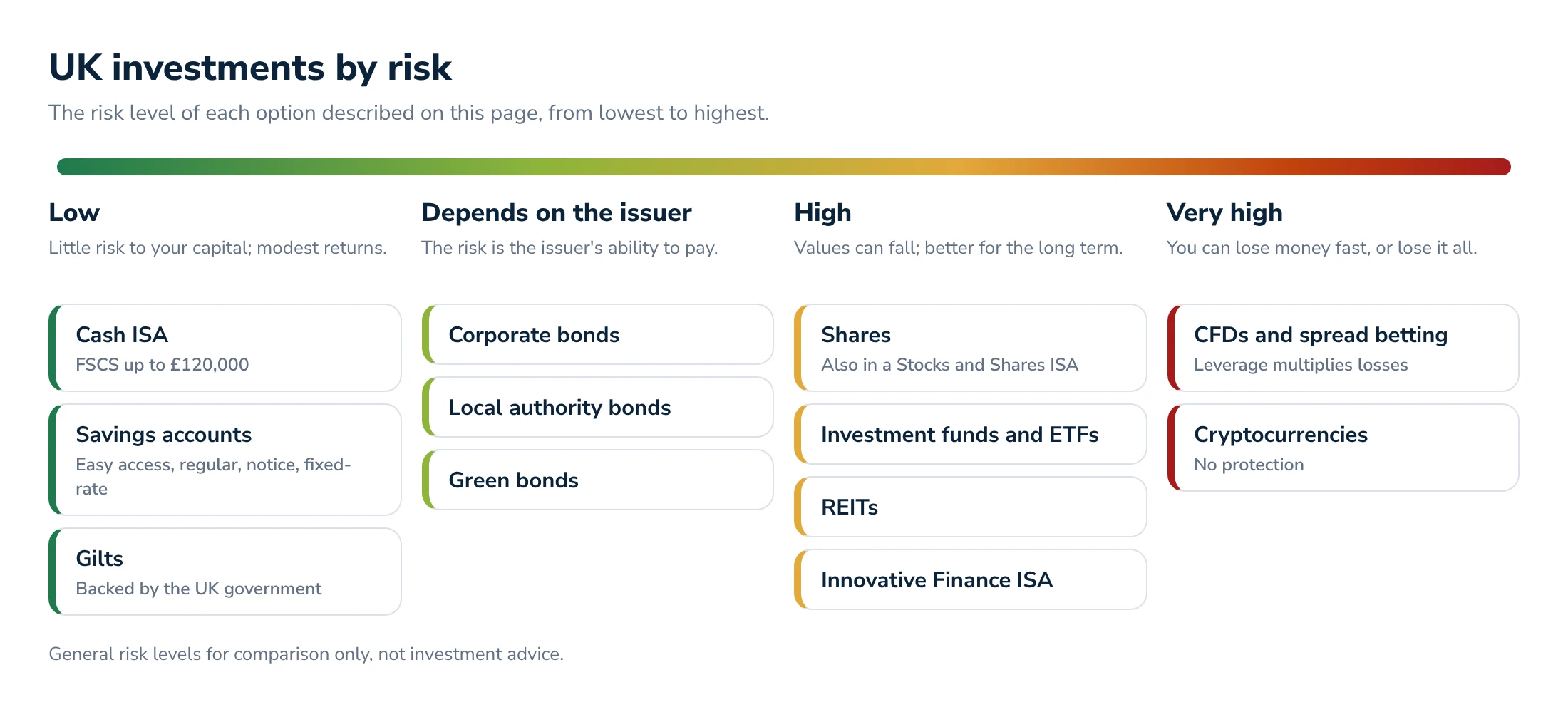
Overview of available investments
- ISAs
- Cash ISA
- Junior ISA (JISA)
- Stocks and Shares ISA
- Lifetime ISA (LISA)
- Innovative Finance ISA (IFISA)
- Savings accounts
- Easy access account
- Regular saver account
- Notice savings account
- Fixed-rate savings account
- Pensions
- Workplace pension
- Defined contribution (DC)
- Defined benefit (DB)
- Personal pension
- Stakeholder pension
- SIPP (self-invested personal pension)
- Workplace pension
- Investment products
- Shares
- Real estate investment trusts (REITs)
- Investment funds (mutual funds)
- Exchange-traded funds (ETFs)
- Bonds and gilts
- Government bonds (gilts)
- Corporate bonds
- Local authority bonds
- Green bonds
- Contracts for difference (CFDs) and spread betting
- Cryptocurrencies
FAQ
- What is the safest investment in the UK? Apart from cash savings accounts, it is usually government bonds (gilts). They are backed by the British government, so they have a very low risk of default, and they pay a fixed interest rate.
- What is the best investment for a monthly income? Several options can work. The best choice depends on your circumstances and your tolerance for risk.
- Where can I earn the most interest? Usually in fixed-rate savings accounts, where you agree to lock your money away for a set period. In exchange for giving up access to the money, you get a higher interest rate than on similar savings products.
- What gives the highest returns? Over long periods, shares have offered higher returns than other types of investment, for example through funds that track an index such as the S&P 500 (500 of the largest US companies) or the FTSE 100 (the 100 largest companies on the London Stock Exchange).
ISAs (individual savings accounts)
An ISA is a tax-efficient savings account, and one of the most popular types of investment in the UK.
- Limit: up to £20,000 per tax year, across all your ISAs. The October 2026 Budget dropped the planned £12,000 cap on cash ISAs from April 2027, so the whole £20,000 can still go into cash ISAs.
- Tax: interest, dividends and gains inside an ISA are tax-free.
- Protection: the Financial Services Compensation Scheme (FSCS) protects cash up to £120,000 per person, per bank, if the bank fails (the limit was £85,000 until 30 November 2025). Investments are protected up to £85,000 if the investment firm fails.
Cash ISA
It works like a regular savings account, but with the ISA benefits.
- Suitable for: short-term savings goals or an emergency fund
- Risk: low
- Withdrawal: at any time
Junior ISA (JISA)
An ISA for children under 18 who live in the UK, which parents can open for their children (and anyone, such as grandparents, can pay into). The money belongs to the child, who can access it at 18.
- Suitable for: parents and grandparents saving for a child’s future
- Risk: low (cash) or higher (investments)
- Limit: up to £9,000 per tax year
Stocks and Shares ISA
An ISA that holds investments such as shares, bonds, investment funds or ETFs. It works like a regular investment account, but with the ISA benefits.
- Suitable for: long-term savings goals, or growing your wealth
- Risk: high
Lifetime ISA (LISA)
You can use a LISA to buy your first home or to save for retirement. It can hold cash, investments or both. You can save up to £4,000 per year, and the government adds a 25% bonus on top (up to £1,000 per year).
- Suitable for: buying a first home worth up to £450,000, or retirement
- Risk: low (cash) or high (investments)
- Who can open one: people aged 18 to 39. You can keep paying in until you turn 50.
- Limit: up to £4,000 per tax year, as part of the overall £20,000 ISA allowance. The government bonus does not count towards the £20,000.
- Withdrawal: to buy a first home (at least 12 months after opening the account), from your 60th birthday, or if you are terminally ill
- Withdrawal charge: 25% for any other withdrawal. It takes back the government bonus and adds a penalty, so you can get back less than you paid in. Since 29 October 2026, the charge is 20% when you use the money to buy a first home worth more than £450,000, so you lose the bonus but not your own money.
Note: In June 2026 the government opened a consultation on a new First Time Buyer ISA, and in the October 2026 Budget it confirmed that the new ISA will replace the LISA for new savers from April 2029. Existing LISA holders can keep paying in under the current rules.
Innovative Finance ISA (IFISA)
An ISA for investing in qualifying peer-to-peer lending and crowdfunding platforms, which match investors with borrowers or businesses.
- Suitable for: investors looking for potentially higher returns than other ISAs
- Risk: high
Savings accounts
There are savings accounts for different saving habits and needs, each with its own benefits and constraints.
- Tax: interest is taxable (above the personal savings allowance)
- Protection: FSCS, up to £120,000 per person, per bank
Easy access account
The most flexible savings account: you can add or withdraw money whenever you want, without penalties. Interest rates are usually variable and lower than those of fixed-rate accounts.
- Suitable for: savings you may need to access quickly
- Risk: low
Regular saver account
A savings account that rewards regular saving with an attractive interest rate, if you commit to monthly deposits.
- Suitable for: saving little by little money you don’t need for everyday spending
- Risk: low
- Limit: usually £50 to £500 a month, depending on the bank
- Withdrawal: may be restricted
Notice savings account
A savings account that requires you to give notice (typically 30 to 90 days) before you withdraw your money. This helps you resist the temptation to dip into your savings, and in return you usually get a higher interest rate than with an easy access account.
- Suitable for: savings you won’t need at short notice
- Risk: low
- Withdrawal: after the notice period, usually 30 to 90 days
Fixed-rate savings account
Your money is locked away for a set period, usually from a few months up to five years. In return, you get a fixed interest rate, typically higher than that of an easy access account.
- Suitable for: money you can leave untouched for the whole term
- Risk: low
- Limit: usually no maximum
- Term: from a few months up to five years
Pensions
A pension is a tax-efficient way to save for retirement, and an essential part of retirement planning.
- Annual allowance: up to £60,000 per tax year can go into your pensions with tax relief (excluding the State Pension). The lifetime allowance, which capped the total of all your pensions at £1,073,100, was abolished in April 2024. The tax-free cash you can take is now usually limited to £268,275.
Workplace pension
A workplace pension (also called an occupational, company or work-based pension) is a pension scheme arranged by your employer. You, your employer and the government all pay into it.
You pay a percentage of your salary every payday, usually deducted automatically, and your employer adds a contribution to your pension pot, which is essentially extra money towards your retirement.
The government also gives tax relief on your contributions: the money that would have gone to the government as income tax goes into your pension pot instead. Under the minimum rules for automatic enrolment, for every £40 a basic-rate taxpayer pays in, the employer adds £30 and the government £10 in tax relief.
There are two main types of workplace pension:
- Defined contribution (DC): the pension pot depends on how much is paid in and how the investments perform. Also called “money purchase” schemes.
- Defined benefit (DB): a guaranteed income based on your salary and how long you have worked for the employer. Also called “final salary” or “career average” schemes.
Personal pension
A pension you set up yourself, whatever your employment status. Like workplace pensions, personal pensions get tax relief. Higher-rate and additional-rate taxpayers claim the extra relief through their tax return.
- Suitable for: the self-employed and people without a workplace pension
There are two main types of personal pension:
- Stakeholder pensions have low and flexible minimum contributions, capped charges and a default investment strategy, which helps if you don’t want to make investment decisions. Many default funds use “lifestyling”: your money is moved automatically into lower-risk investments as you approach retirement.
- A SIPP (self-invested personal pension) works in a similar way but offers a wider choice of investments. You have more control over your pension pot and can invest in shares, bonds, funds and even commercial property.
Investment products
Shares
Shares, also known as equities or stocks, represent ownership of part of a company. As a shareholder, you can profit in two ways:
- Capital gains: if you sell your shares for more than you paid
- Dividends: the part of the company’s profits paid out to shareholders, in proportion to their shares
Shares are traded on stock exchanges; the London Stock Exchange is the main one in the UK.
- Suitable for: bolder investors, who accept possible losses for the chance of greater gains
- Risk: high. Share prices can be volatile and move with the company’s results, the economy and market sentiment.
Real estate investment trusts (REITs)
REITs are companies that own, and often operate, income-producing property. Investing in a REIT lets you invest in property without owning any real estate yourself: homes, commercial property such as offices and shopping centers, or specialist property such as hotels.
REITs must pay out most of their taxable income to shareholders, which makes them attractive for investors looking for regular income, much like dividend-paying shares. They can also grow in value if the underlying properties do.
- Suitable for: investing in real estate without buying a property
- Risk: high (property values and rental income can fall)
Investment funds
Investment funds (mutual funds) pool your money with other investors’ money to invest in a wide range of assets, including shares, bonds and property.
- Active funds: professional fund managers decide where to invest, aiming to beat the market or a benchmark. In return, active funds usually charge higher fees than passive funds.
- Index funds: also called tracker funds in the UK, they aim to match the performance of a market index, such as the FTSE 100, instead of trying to beat it. This passive approach usually means lower fees, making them a cost-effective way to diversify.
By pooling money, funds give access to a range of investments you might not be able to afford on your own, spreading the risk.
- Suitable for: investors who want to spread their money over many assets
- Risk: high
Exchange-traded funds (ETFs)
ETFs are investment funds whose shares are traded on stock exchanges, like individual shares. They can track a wide range of indexes, from broad market indexes to specific sectors, commodities or regions. They are a flexible and cost-effective way to diversify, and you can buy or sell them at any time during the trading day at market prices.
- Suitable for: long-term investors who want to spread their money over many shares
- Risk: high
Bonds and gilts
A bond is a loan from an investor to a borrower, usually a company or a government. When you buy a bond, you lend money to the issuer in return for regular interest payments and the return of the bond’s face value when it matures.
Bonds can provide a predictable income and are generally seen as less risky than shares.
- Risks: credit risk (the issuer may fail to pay) and interest rate risk (when interest rates rise, the value of the bond falls)
- Tax: depends on the type of bond and on the investor’s country of residence
There are several types of bonds:
Government bonds (gilts)
UK government bonds, called gilts, are among the safest investments because they are backed by the government. They pay a fixed interest rate (the coupon) twice a year until they mature, when the investor gets the face value back. A gilt’s term can range from a few years to several decades. Gains on gilts are free from capital gains tax; the interest is taxable.
- Risk: low (backed by the government)
Corporate bonds
Issued by companies to raise money, for example to fund growth or to pay off other debts. They usually pay more interest than government bonds to make up for the extra risk, since they depend on the company’s ability to pay. They can provide a regular income and diversify a portfolio. Retail bonds are corporate bonds sold directly to the public, and can be traded on the London Stock Exchange’s Order Book for Retail Bonds (ORB).
- Risk: depends on the issuer
Local authority bonds
Issued by local councils to finance public projects. They often pay competitive interest rates, which makes them an option for investors looking for a balance between risk and return.
Green bonds
A newer addition to the bond market: the money raised funds projects with environmental benefits, which suits investors who want their money to support sustainability.
CFDs and spread betting
Contracts for difference (CFDs), spread betting and similar derivatives are another option for retail investors. However, they are high-risk, complex products and may not be suitable for everyone.
- Risk: high, and very high for inexperienced investors
- Tax: tax rules can change and may depend on your circumstances
CFDs
A CFD is a derivative used to speculate on the price of fast-moving markets, such as shares, indexes, commodities, currencies and bonds. When you trade a CFD, you agree to exchange the difference in the price of an asset between the moment the contract is opened and the moment it is closed. You never own the asset, but you profit if the market moves in your favor and lose if it moves against you. Because of leverage, CFDs carry a high risk of losing money fast. They are legal in the UK, but the Financial Conduct Authority (FCA) restricts how they are marketed and sold to retail customers, because of the losses.
- Risk: high
- Tax: profits are subject to capital gains tax. There is no stamp duty, because you never own the underlying asset.
Spread betting
Another type of derivative trading, where you bet on the direction of a price. The provider quotes two prices, the bid and the offer (the difference between them is the spread), and you bet on whether the price will end up below the bid or above the offer. The main difference from CFDs is the tax treatment.
- Risk: high
- Tax: none. Profits are free from capital gains tax and stamp duty, because HMRC treats spread betting as gambling. For the same reason, losses cannot be set against other gains.
- Protection: providers are regulated by the FCA and must meet certain standards, including keeping client money separate.
Cryptocurrencies
Cryptocurrencies are a fairly new addition to the investment landscape and have drawn a lot of attention around the world, including in the UK. They are a form of digital currency secured by cryptography, which makes them nearly impossible to counterfeit, and they are bought and sold on online exchanges. The best known is Bitcoin.
Their high potential returns can be appealing, but cryptocurrencies are highly volatile and their value can swing a lot.
- Risk: very high
- Other risks: besides volatility, scams are frequent in the crypto market
- Protection: none