Overview
“In this world nothing can be said to be certain, except death and taxes.” Benjamin Franklin, 1789
I couldn’t start talking about taxes without quoting these famous words.
What is a tax?
A tax is a compulsory financial charge or other levy imposed on a taxpayer by a government to fund public spending.
Yes, that’s the dictionary definition, and everyone knows what a tax is, right? Still, some basic differences cause confusion.
Direct and indirect taxes
The exact definition varies a little from region to region, but the basic rule is:
- Indirect tax: a tax on goods and services (e.g. VAT)
- Direct tax: a tax on income or profits (e.g. income tax)
In short: you pay direct taxes to the government yourself, while indirect taxes are collected by the seller and passed on to the government. Again, this may vary from region to region.
Indirect taxes
Indirect taxes have different names around the world:
- Europe: VAT (value-added tax)
- United States: sales tax
- Australia: GST (goods and services tax)
- Japan: JCT (Japanese consumption tax)
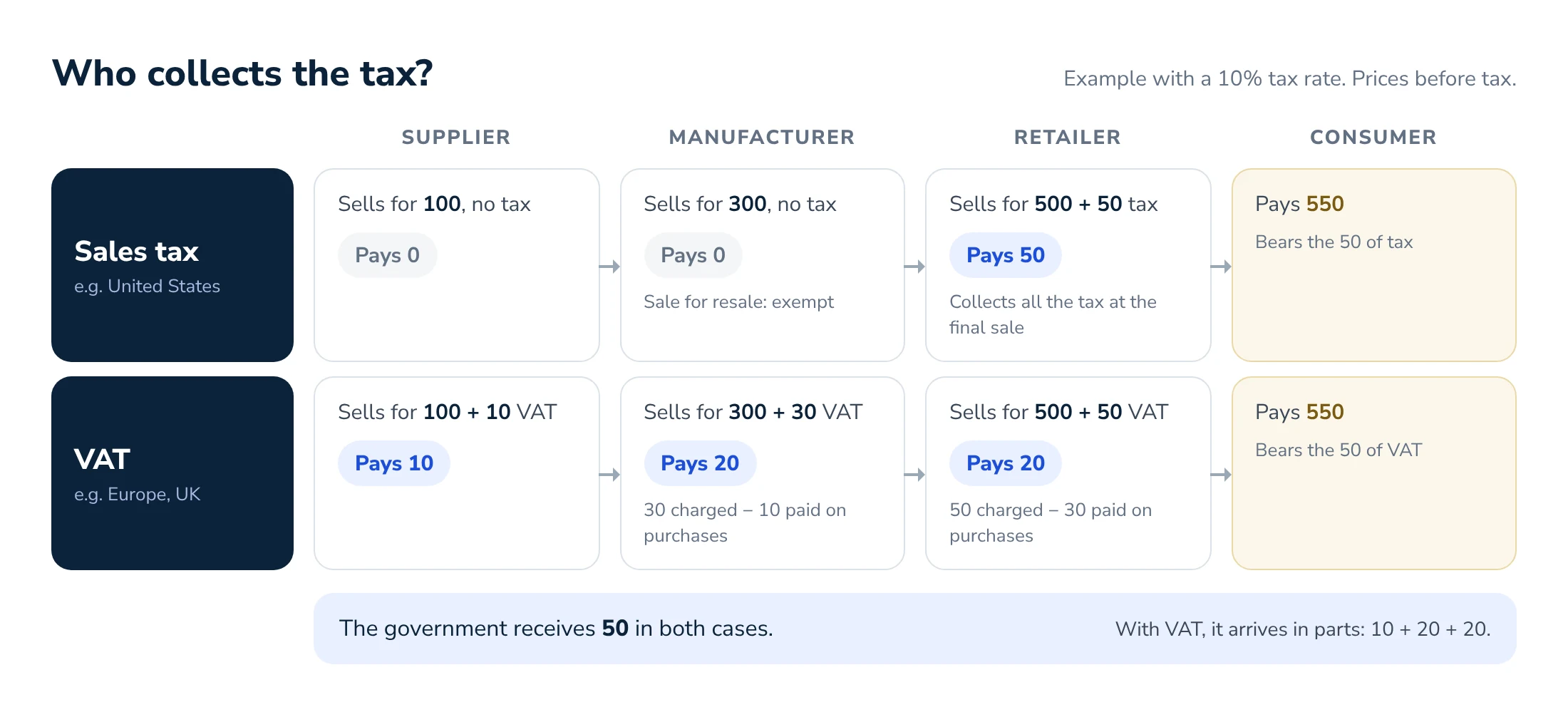
The way these taxes are collected can vary a lot, but the outcome is the same: the end customer pays the tax. For example:
- Sales tax is collected only by the retailer, at the final sale in the supply chain.
- VAT is collected at every stage of the supply chain. Suppliers, manufacturers, distributors and retailers all charge VAT on their taxable sales, and all of them, end consumers included, pay VAT on their purchases. Businesses must track and document the VAT they pay on purchases to get a credit for it on their VAT return.
Potential advantages
- It is easier for consumers to understand and accept
- It is easier for businesses to pay indirect taxes than for consumers
- Countries can levy import duties to protect their domestic economy
- It can reduce demand and correct market failures by changing behavior (e.g. a cigarette tax can help reduce smoking)
Potential disadvantages
- Indirect taxes weigh more on people with lower incomes because they are regressive: everyone pays the same tax on the same purchase, so people with lower incomes spend a higher share of their income on it
- They can encourage tax evasion (for example, high cigarette taxes can feed the black market)
Direct taxes
Direct taxes follow the economic principle that whoever has more resources or earns more should bear a higher tax burden. They are also seen as unavoidable: there is no choice but to pay.
GST overview
The GST (goods and services tax) is a kind of VAT levied on most goods and services sold for domestic consumption.
The tax is included in the final price: consumers pay it at the point of sale, and the seller passes it on to the government. Many countries apply a single national GST rate, which simplifies the tax system and reduces tax evasion; India is an exception, with several rates.
Warning: The list below is indicative only. It changes as countries adopt or change their GST schemes.
Countries with a GST:
- Australia
- Bhutan (since January 2026)
- Canada
- India
- Maldives
- New Zealand
- Papua New Guinea
- Singapore
Malaysia had a GST from 2015 to 2018, when it went back to a sales and service tax (SST).
Article written by Luiz C. Mariani, published in June 2023.