Overview
Macroeconomics is a branch of economics that deals with the performance, structure, behavior and decision-making of an economy as a whole, including regional, national and global economies.
This section covers episodes from economic history as lessons learned: what to do and what not to do.
Fordlândia
The Guardian told this story in its “Lost cities” series as “Fordlandia – the failure of Henry Ford’s utopian city in the Amazon”.
In the 1920s, the American industrialist Henry Ford wanted to found a city based on the values that had made his company a success, while, of course, producing cheap rubber.
Spoiler alert: the jungle city that bore his name became one of his biggest failures.
Location
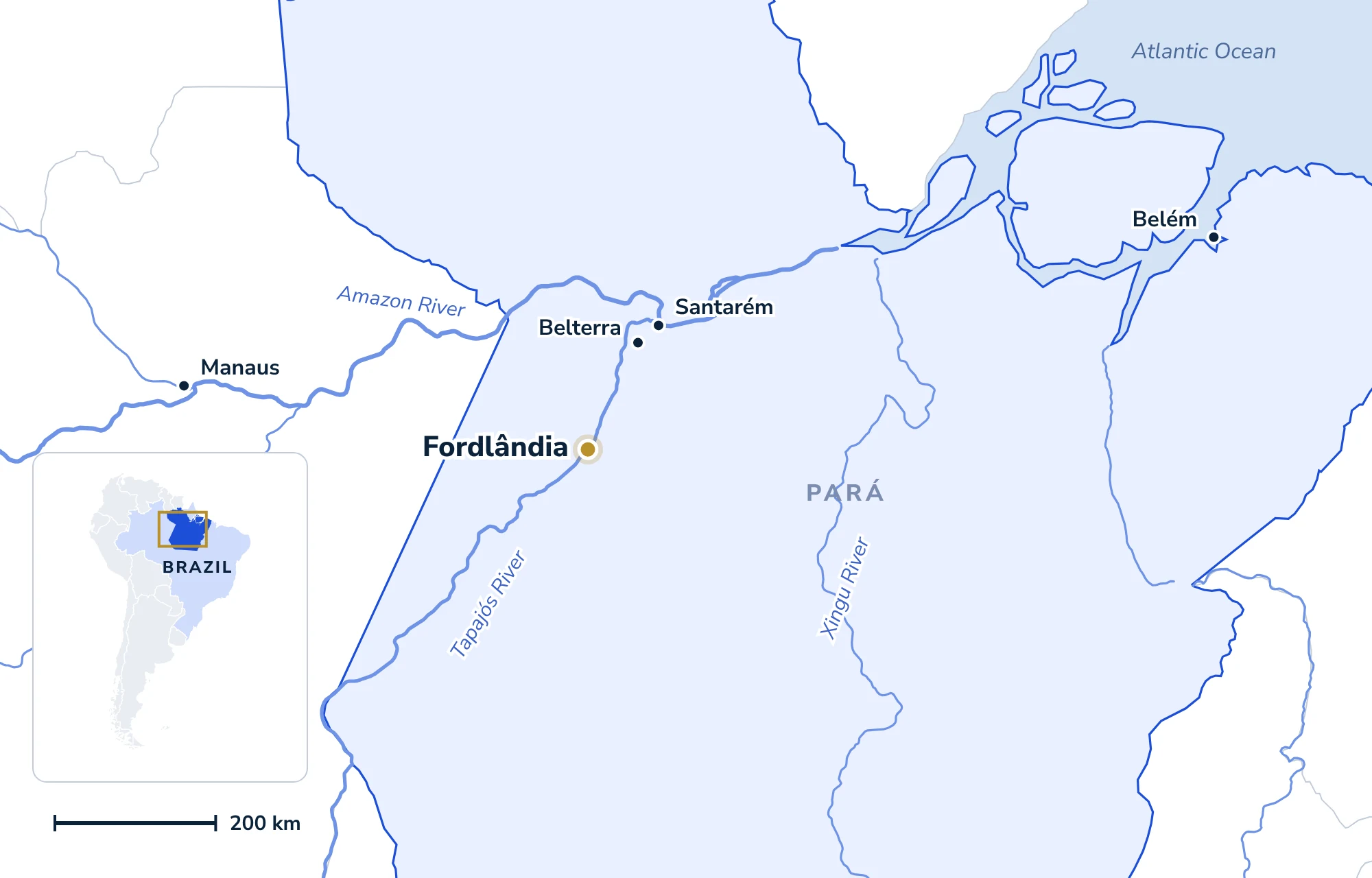
Fordlândia is a district of the municipality of Aveiro, in the Brazilian state of Pará, covering 14,268 km² with its surrounding area. It lies on the east bank of the Tapajós River, roughly 300 km south of the city of Santarém.
Period and purpose
It was established in the Amazon rainforest in 1928 as a prefabricated industrial town meant for 10,000 people, to secure a source of cultivated rubber for the car factories of the Ford Motor Company.
Background
Negotiations with the Brazilian government started when the then governor of Pará, Dionísio Bentes, visited the United States to meet Ford. Under the agreement, Ford received an area of about 10,000 km² and was exempted from taxes on the export of goods produced in Brazil, in exchange for 9% of the profits: 7% for the Brazilian government and 2% for the local municipalities.
Investment and infrastructure
With an investment of around US$2 million at the time, 2,000 people moved to the region. According to historian Greg Grandin, author of the book Fordlandia (2009), the town copied every detail of a typical American town, with a main shopping street, rows of houses designed in Michigan, sidewalks and a central square.
There were also hospitals, schools, workshops and cold stores for food, among other facilities that were rare in the region at the time.
Rules and cultural distance
Ford, who was against drinking, wanted a perfect utopian town in the middle of the Amazon. The managers imposed a strict set of rules: alcohol, women, tobacco and even football were forbidden within the town, including inside the workers’ own homes. Inspectors (American managers) went from house to house to check how tidy the homes were and to enforce these rules, while the company promoted gardening, square dances and poetry readings for the workers.
According to sources, Ford himself chose a menu of balanced meals: oatmeal and canned peaches imported from Michigan for breakfast, and brown rice and whole-wheat bread for dinner.
Time clocks and sirens marked the working hours, and the drive for productivity, a Ford trademark, felt strange to Brazilians at the time.
The legendary businessman, however, had not counted on the cultural differences between the American engineers brought in to run the venture and the Brazilian rubber tappers. That cultural distance was the beginning of the end of the American utopian town in Brazil.
Riots
On 22 December 1930, in the workers’ cafeteria, where skilled workers were kept apart from manual laborers, an argument quickly escalated and violence broke out. Workers vandalized the town, destroying generators, machinery and even their own homes.
The managers fled, and order was only restored when the Brazilian Army arrived. An agreement was then reached on the food served to the workers, but Ford refused any further negotiation and dismissed most of the workforce.
Downfall
Even after the riots, Fordlândia kept running into problems:
- Treatment of workers
- Work in the middle of the day under the tropical sun, in the heat and humidity of the rainforest
- Cultural differences
- Unfamiliar food
- American-style housing
- Lack of knowledge of tropical agriculture
- Hilly, rocky land
- No protection against pests and diseases: in the wild, rubber trees grow far apart from each other, which keeps pests from spreading, but the plantations put them close together
- Logistics
- No roads in the area
- Access only by the Tapajós River
- Biological risks
- Workers affected by diseases such as yellow fever and malaria
- Leaf blight, a fungal disease, made the rubber plantations useless for industry
- Competition
- New synthetic rubber made from petroleum
- Asian rubber plantations, freed from Japanese occupation at the end of World War II
In 1934, Ford moved the plantations downriver to Belterra, closer to Santarém. In 1945, the company sold both towns back to the Brazilian government, at a loss of more than US$20 million.
Ford stayed in Brazil and tried other paths in the following decades, such as new factories in other regions and Autolatina, a joint venture with Volkswagen (1987–1996). After an unfavorable economy and successive crises, including the COVID-19 pandemic, Ford stopped manufacturing cars in Brazil in 2021, about a hundred years after it arrived in the country in 1919.