Overview
In its most common sense, methodology is the study of research methods. However, the term can also refer to the methods themselves or to the philosophical discussion of the assumptions behind them.
A method is a structured procedure for reaching a certain goal, like acquiring knowledge or verifying knowledge claims. This normally involves several steps, like choosing a sample, collecting data from it and interpreting the data. The study of methods describes and analyzes these processes in detail. It also evaluates them, comparing different methods to assess their advantages and disadvantages and the research goals they suit. These descriptions and evaluations depend on philosophical assumptions, for example how to conceptualize the phenomena studied and what counts as evidence for or against them. In its widest sense, methodology also includes the discussion of these more abstract issues.
Methodologies to save time
Eat the frog
Identify one challenging task (the frog) and complete it first thing in the morning (eat it). In other words, eating the frog means finding the most difficult task of your day and finishing it before you do any other work.
3-3-3 method
- 3 hours of deep work: the most critical and important things
- 3 shorter tasks: urgent tasks that you have been avoiding but need to get done
- 3 maintenance tasks: activities that keep life in order
5/25 rule (attributed to Warren Buffett)
- List your top 25 goals
- Rank them by importance
- Focus only on the top 5
- Avoid the other 20 at all costs: they are the ones that distract you from the top 5
80/20 rule (Pareto principle)
The 80/20 rule says that 80% of outcomes come from 20% of causes.
It puts first the 20% of factors that produce the best results. The idea is to identify your best assets and use them efficiently to create the most value.
- Identify the vital 20% that will produce the best results
- Focusing on that 20% eliminates or reduces the trivial 80%
Pomodoro technique
- Choose a task
- Set a timer for 25 minutes
- Work until the timer goes off
- Take a 5-minute break
- After 4 cycles, take a 15 to 30-minute break
ABCDE method
Sort your tasks into categories and do them in order of importance:
- A: most important
- B: important
- C: nice to do
- D: delegate
- E: eliminate
MoSCoW method
- Must have: critical for the project’s success
- Should have: important, but not critical
- Could have: desirable, if time and resources allow
- Won’t have: left for future phases
Pickle jar method (glass jar)
Always start with the rocks (high-priority tasks), followed by the pebbles (medium-priority tasks) and then the sand (low-priority tasks). Finish by filling the jar with water (“off” time).
- Do the major tasks first
- Fit the minor tasks around the major ones
- Keep reassessing and reprioritizing your tasks
1-3-5 method
The 1-3-5 rule keeps a daily to-do list realistic: each day, you plan to accomplish one big task, three medium tasks and five small ones.
- 1 major task
- 3 medium tasks
- 5 small tasks
Eisenhower matrix
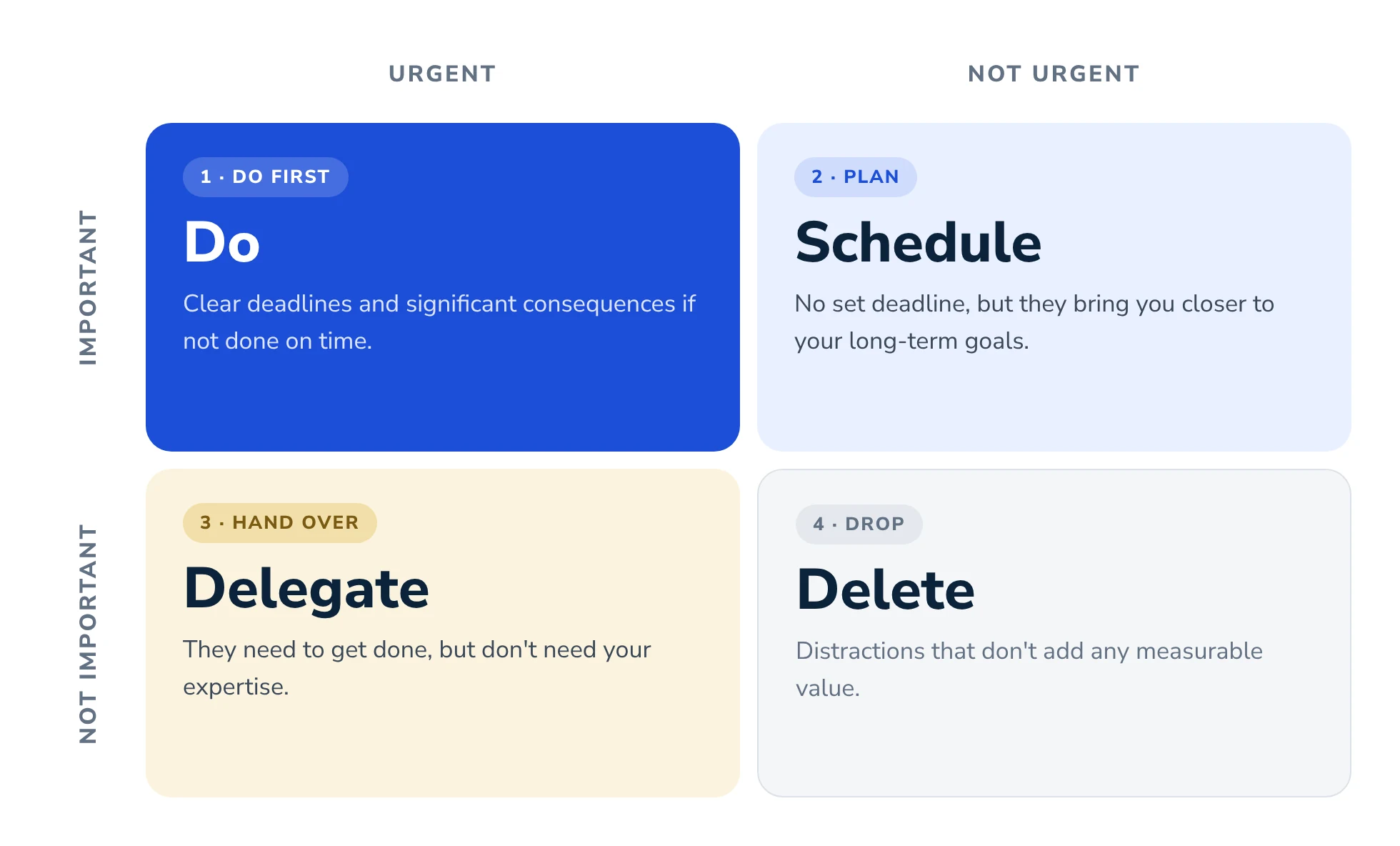
The Eisenhower matrix is also known as the time management matrix, the Eisenhower box or the urgent-important matrix. It divides your tasks into four categories: the tasks you will do first, the tasks you will schedule for later, the tasks you will delegate, and the tasks you will delete.
- Important and urgent: do. Tasks with clear deadlines and significant consequences if they are not done on time.
- Important, not urgent: schedule. Tasks with no set deadline that bring you closer to your long-term goals.
- Not important, urgent: delegate. Tasks that need to get done, but don’t need your expertise.
- Not important, not urgent: delete. Tasks that distract you from your course and don’t add any measurable value.
Getting Things Done (GTD)
The GTD method is based on the belief that the more information you keep track of in your head, the less productive and focused you are. Instead of relying on your memory, GTD encourages you to keep all your work information in an external, organized source of truth.
- Capture your tasks
- Clarify what they mean
- Organize them into lists
- Reflect on your progress
- Engage: take action
2-minute rule
The 2-minute rule helps reduce procrastination by getting the small tasks that are often overlooked out of the way.
- If a task takes less than 2 minutes, do it now
- If it takes longer, delegate it or schedule it for later
Task batching
Task batching means grouping similar tasks and doing them all at once. It helps you avoid multitasking and gives you more time to focus.
- Sort similar tasks
- Block dedicated time
- Do the tasks in batches
Time blocking
Time blocking means planning how you will spend each day, one block at a time. For every task, estimate roughly how long it will take and add that time to your calendar. For example:
| Time | Block |
|---|---|
| 08:00 – 11:00 | Deep work (your most important tasks) |
| 11:00 – 11:30 | Quick tasks (emails, phone calls, etc.) |
| 11:30 – 12:30 | Break (eat, exercise, relax) |
| 12:30 – 14:00 | Important tasks (projects, planning, etc.) |
| 14:00 – 16:00 | Meetings (one-to-ones, follow-ups) |
Agile methodology
Agile is a project management approach that breaks a project into phases and emphasizes continuous collaboration and improvement. Teams follow a cycle of planning, executing and evaluating.
Kanban
Kanban is one of the best-known Agile methods. It makes the work visible on a board, with one column for each stage (for example, to do, in progress and done). Each task is a card that moves across the board. Teams limit how many tasks can be in progress at the same time (WIP limits), so the work flows steadily and bottlenecks show up early.